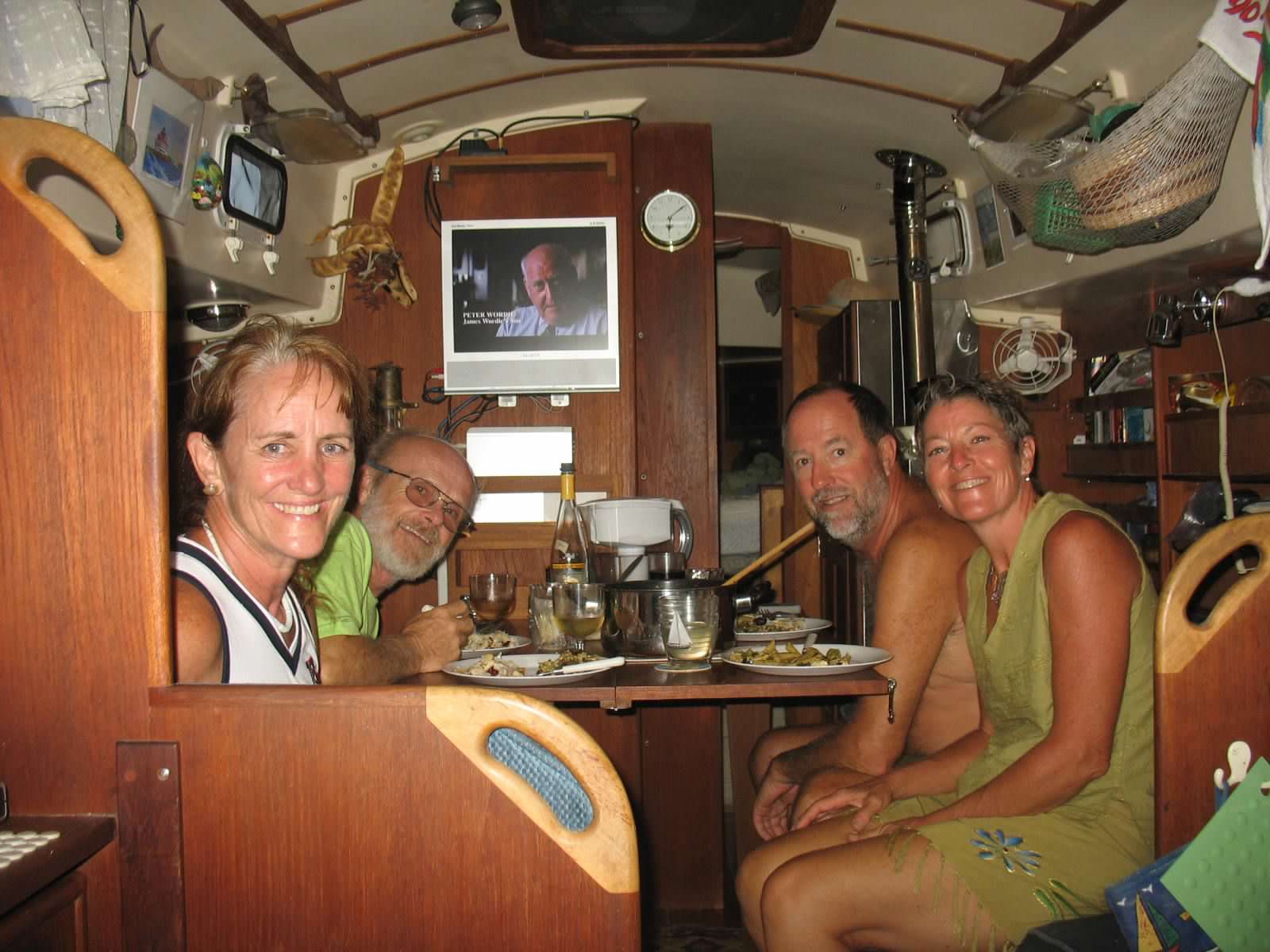
Oh the life of a cruiser… About a week before departing for Rio Macareo (Venezuela), customs closed the only fueling location (Powerboats) that cruisers use. The locals also purchase fuel from Powerboats. The fuel is subsidized by govt and has always been illegal to sell to cruisers but has been ignored up until apparently someone complained about a foreign power boat that took LARGE quantity of fuel and occupied the dock for a few days. Powerboats didn’t have a International license (paying $4 vs $1 US per gallon) to sell fuel nor a spare pump so this created a problem for us and felt like we were held hostage. As cruisers do they tried finding other means to purchase fuel via jugs – via renting car (paying taxi drivers) to take to gas station ½ hour away or find another illegal water front location out of the mainstream to purchase fuel when customs wasn’t looking.
So we went to check out of Trinidad with immigration/customs and to inform them that where we are going there are no customs/immigration agents. They said well you need to find one… We hope a different agent is there when we return. During the trip we decided that we would create a custom/immigration form and have Collins sign it. He is as official as we would find. More about Collins below. His signature appeared like a 6 year old so decided that he could speak english but probably not write/read. Upon our return to Trinidad the agents asked for the Venezuela forms so we handed them Collins signed forms and gave it a funny look but decided to take it and not ask any questions.
We arrived at the Rio Macareo, a tributary to the Orinoco on Saturday, August 30th. We are traveling with one other boat, “Southern Cross”, Dee and Don who are from Ohio that we just met. We are in Venezuela but are not exactly legal as there is no where close by to check in with customs and immigration. Oh well, many other boaters have preceded us and done the very same thing without incident so we were pretty sure things will be okay. The only charts are what other cruisers have created and passed along. The entrance is the worst as we cautiously passed the 6-8 feet unmarked channel on a rising tide. Once we got past this we did go to far east and grounded in mud but got off quickly. Our first night was spent anchored next to a mangrove “island” where white and scarlet ibis roost for the night. They arrive just about at sunset in large flocks and it reminds one of a Christmas tree with red and white ornaments nestled in the green mangroves. The current in the river is very strong, 3 knots or sometimes more which makes for very slow movement upstream where you hug the inside shores. It averages around 20-30 ft but often shoals to less than 10 feet in no time. To add insult to injury huge rafts of hyacinths, lily pad type vegetation float down with the current and foul the anchor rode so it must be cut away periodically with a machete. Other times its bamboo and prickly trunks where we had to use a dinghy to pull it off along with lifting via anchor.
The water is very cloudy brown, I assume because of runoff from the interior of the country. Due to the current, the boat never moves once anchored so is very odd and the chain in fowled with fine/stringer hyacinth roots. We put up our sun awnings early on and left it up until returning to the sea. The river is also home to the Piranha so I don’t plan to do much of any swimming, even though the Wareo, indigenous people swim without any fear. The fresh water was WONDERFUL. Rose did swim/drift a couple times by holding on to rope behind dinghy just to cool down as the sun was hot… Tom was not as brave so would use the wash down pump to cool down. It rained a few times so we would definitely catch drinking water, run out to shower off and wash down the boat. You would want to rinse and add Betadine to any cuts to prevent bacteria growth. The locals would drink the water even though there can be Cholera here. Malaria and Dengue Fever are also an issue in Venezuela.
We weren’t careful soon enough by putting on STRONG deet insect repellent after 5pm and finding all the leaks in our hatch screens. Tom had the worst reaction to prehistoric looking black flies, tiny mosquitos, nats and horse flies. His MANY bites on his feet would swell up and turn purple. It felt like the black flies would first penetrate a numbing agent before biting so you wouldn’t notice them.
We have brought some things from Trinidad to trade with the Wareo, colorful material, needles, thread, scissors, etc for making clothing. Plus paper, pencils, toothpaste and toothbrushes, shampoo, personal hygiene things that they have to travel many miles up river to obtain. In return we are offered woven baskets made of palm or hyacinth, used oars carved from trees, beaded necklaces, fruit, fish, Chavez hats, (some VERY thin and boney), etc. It was initially abit intimidating as the whole village sees you coming and come out to trade (Cambio) in their canoes before you can even anchor. So at times you tie up 1-2 canoes on each side and others hang on to them and are very interested in how you anchor. Some Wareo are more skilled in trading and ask for lots in return. We truly believe that they have no idea what things cost or other cruisers have given similar items in exchange so a learned behavior. In seeing the smiley children faces and how poor they are – you can’t help to want to give them anything they want spoken in broken Spanish. But you don’t want to encourage begging as it would again change their culture. So our levels of Spanish are somewhat similar.
The name Wareo/Warao/Warrau means “canoe people”. They are semi-nomadic, gentle, small, fine featured, reddish skinned people that live along the river bank in small open huts built of mangrove/etc. wood on tree trunk piles by the river bank. The thatch or corrugated aluminum (newer) roofed huts “palofitos” are linked by walkways. Some of the more prominent Wareo have separate hut for sleeping vs cooking. They cook with wood open fire with dirt protecting the fire from the wood tree platform. They travel mostly by dug out canoe hugging the edges to/from side cano’s for provisions. Their diet consists of largely fish, roots, flour, sugar, fruits, they have or trade with other Wareo. We found one of the fruits they traded us way up a palm tree. They bury their dead in the jungle under a small hut in wooden coffin covered with mud by a Wisiatu (shaman). Afer a year the Wisiatu goes back to the grave to study the bones to decide who is guilty of the death and how much they have to pay.
As you might imagine, we need to be totally self sufficient, bringing enough fuel, food, water (collecting rain water), etc for the entire trip as there is no where to go for provisions and help is perhaps days away. That is why most people will travel with a “buddy boat” just to be on the safe side. We found it difficult to figure out how to dispose of garbage as there was no dry land to burn it. We would sink steel cans and glass bottles. There is one eco resort at 60nm (Lau Lau Lagoon – Flotel Warao) who took a small bag each of paper/plastic garbage. They were amazed that this was all we had for 2 ½ weeks of travel. The aluminum cans and plastic bottles we will bring back to Trinidad.
We obtained Pirogue Mail from Collins from Macareo Village telling us he can’t be with us as not feeling well but to let him know when we were ready to have him take us to Tucupita for a visit of a mainland town. Collins, 42 yrs old, left Guyana with his father at age 7 to live on river near here and is only local we know that speaks English, Spanish and Wareo. He married a Wareo (Elena) and has 9 children that all still live next to his home. He is catholic and not what the Wareo spiritual beliefs are other than based on nature.
Little did we know that we would need Collins for a different purpose. We lifted our 2006 Yamaha 15 hp outboard ($2K) Friday night Sept 5th but forgot to lock it. It was stolen that night (its the first time EVER we had NOT locked it). We were at Cano Guapoa and had sent email to Collins via Luis at the Foundation LaSalle via SSB. Unfortunately Luis was gone so it took till Sunday for Collins to find out. It’s a good thing we went to visit the Foundation at Macareo Village which Luis from Margarita he has managed for 4 years as it provided us a email address. They provide monetary assistance to the clinic, school, biological research of fish life and fish education. Since this village is close to the sea Chavez also provided pirogues and motors to allow them to fish in the sea and sell. We have heard that recently he has been taken back motors of people that didn’t vote for him. We immediately went to the Wapowa Village and dinghied down current to Nabasanuca asking for help in finding our motor. Our spanish is limited but they got the message. After Collins spoke to Wapowa Village and found Wapowa Chief Perro in Tucupita. He arranged to bring Chief Perro and Fran (Boca La Tela) to visit Wapowa village and they believe that it was stolen by some locals that live on Cano Largo that come to Cano Guapoa to fish/hunt to sell in Tucupita. So Collins has some scouts monitoring the situation as of Sept 22nd these guys have still not returned home. Collins is still hopeful that he will find this motor. We plan to stay in Trinidad another week and possibly haul here to paint bottom versus doing in Venezuela even though it was abit cheaper. But we continued to spread the word to piroges we can stop traveling up/down river.
The 2 hour trip with Collins to mainland Tucupita was interesting in that the terrain changes with higher sandy banks where you can see buffalo and cattle ranches. But the banks are slowly eroding and will impact Blanco Village at some point. Collins took us via pirogue via Cano Largo to dead end where we walked down a road and across a bridge where we jumped into a truck to town. The town was very basic with a traditional square, a good grocery store and summer Wareo village where they made hyacinth baskets. Most Wareo don’t take the 6 hour canoe journey to Tucupita and rely on other traders that have a small store in larger villages.
Within 60nm we traveled there were 2 schools that we gave donations to and the kids sang to us in Wareo. They teach Wareo and Spanish to the children. Boca La Tela village had some huts built by Chavez that were set far from the river bank and in the wet season was VERY muddy to walk back to. Some Wareo still move to different huts in winter vs summer so feel like this new set up was prone to disease and difficulty in keeping pigs/chickens alive. The Macareo Village had some of the same type buildings but with long walkways to the river. Collins’ son Lorenzo’s wife, Leni is the head mistress at Macareo School which started on Sept. 22nd. There are 80+ children, 4 teachers with grades primary to 5th in 3 classrooms also built by Chavez! Lena is Wareo from another river and raised in abit higher economic style. She wears western clothing whereas rest of the women here where colorful dresses made with tight top, V neckline so can breast feed, capped sleeves and full bodice so can wrap skirt between legs while sitting. The younger women where western tops and similar full skirts whereas younger kids are either naked or where western clothes.
Most early mornings and late afternoon we would take our dinghies in a side cano (river channels) to drift and watch for wild life and fauna. Its fascinating to listen to the sounds and see colorful Tucan, McCaw, Hoatzin, kingfisher, green parrots, scarlet ibis, hawks, Howler (whose LOUD sound like lions) and White Capachin monkeys, pink dolphins, caiman, pirana, huge spiders, bats, irridescent blue butterflies, etc.
Prior to leaving the river we hung out at Macareo Village and spent a day with Collins family, watching his wife Elena demonstrate how to make hammacks, bead jewelry and sew along with teaching the children how to play a dice/chip game called LCR which we gave to them afterwards. Its was fun to interact and just watch their daily life. Since this village is so close to the opening to sea there appears to be much trade (illegal?) there with boats coming from Trinidad (15 miles away) and Tucupita, Vene. One evening we went caiman hunting and saw the red eyes via flashlight and at times motor up to them before they dash into the water. We did get upclose to a very young caiman that probably doesn’t have much fear yet. Its best to go on a low tide and no moon.
It was a fascinating and wonderful trip. So different from anything we have been on during our cruising life. Dispite the monetary loss of our outboard, we continue to feel blessed to be able to experience culture in this way. Thanks for reading and continuing to keep us posted as to your life.
Live your Dreams!
2 responses to “Macareo River – Venezuela – Home of Wareo Indian 10-2008”
Tom & Rose,Glad to hear you had a wonderful trip up the river. The photographs are great (as always) and the narrative made the trip come alive. Be well and we will see you again some day.Best,Dave
Thanks for the update. Loved your pix and the overall design of your web site. Glad to hear you\’re both doing well. Looks like Tom has lost some weight. You look good Mac.
The Phillies beat LA last night to win the pennant. Tonight The Devil Rays take on the Red Sox in game 5. Rays are up 3 games to 1. Obama is pulling way ahead in the polls, and it looks like he\’ll be our next president. Last night in the debate, Mccain looked like a person who was off his meds. Kind of scary.
Minnesota is gold and red these days. I know this is your favorite season in MN. Blue skies and crisp fresh air.
Take care.
Tom T.