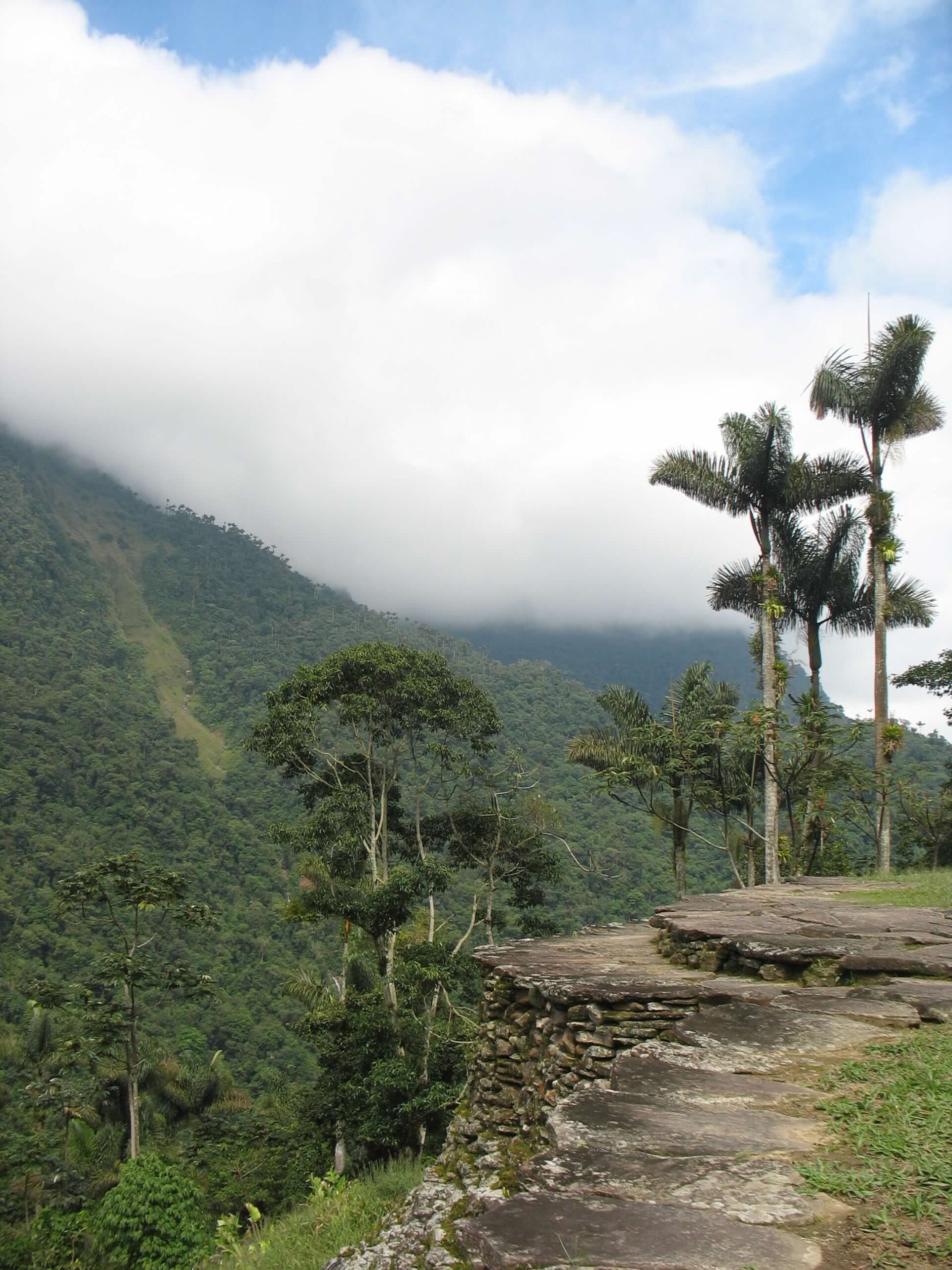
Ciudad Perdida – Lost City near Santa Marta, Colombia, November 18, 2009
It is the archaeological site of an ancient city in Sierra Nevada, Colombia. It is believed to have been founded about 800 A.D., some 650 years earlier than Machu Picchu. This location is also known as Buritaca and the Native Americans call it Teyuna.
Ciudad Perdida was discovered in 1972, when a group of local treasure looters found a series of stone steps rising up the mountainside and followed them to an abandoned city which they named “Green Hell” or “Wide Set”. When gold figurines and ceramic urns from this city began to appear in the local black market, authorities revealed the site in 1975.
Members of local tribes—the Arhuaco, the Koguis and the Arsario—have stated that they visited the site regularly before it was widely discovered, but had kept quiet about it. They call the city Teyuna and believe it was the heart of a network of villages inhabited by their forebears, the Tairona. Ciudad Perdida was probably the region’s political and manufacturing center on the Buritaca River and may have housed 2,000 to 8,000 people. It was apparently abandoned during the Spanish conquest.
Ciudad Perdida consists of a series of 169 terraces carved into the mountainside, a net of tiled roads and several small circular plazas. The entrance can only be accessed by a climb up some 1,200 stone steps through dense jungle ending at around 1300 meters.
Unfortunately, the area was at one time affected by the Colombian Civil War between the Colombian National Army, right-wing paramilitary groups and left-wing guerilla groups like National Liberation Army (ELN) and Revolutionary Armed Forces of Colombia (FARC). On September 15, 2003, ELN kidnapped 8 foreign tourists that were visiting Ciudad Perdida, demanding government investigation of human rights abuses in exchange for their hostages. ELN released the last of the hostages three months later. The AUC paramilitary group declared itself protector of this area. The Colombian Institute of Anthropology avoided the area after the kidnappings occurred and access to tourists was also restricted.
In 2005, tourist treks became operational again. The Colombian army actively patrols the area, which is now deemed to be safe for visitors and there have not been any more kidnappings. For a 6 day return trek to the lost city, the cost is approximately US$250. This includes one night staying at the lost city. The trek is about 52 km of walking in total, and requires a good level of fitness. The trek includes a number of river crossings and steep climbs and descents. It is a moderately difficult trek.
My Thoughts:
I (Rose) organized this trip via announcing it on the Cartagena VHF net. Two other cruisers around my age decided to join me which was great as Tom decided his knees were not going to be acceptable. We met up in Santa Marta (took a bus) to get driven to nearby Taganga to stay in a new hostel under construction. The next morning we were shuttled back to Santa Marta to meet up with the rest of the trekkers (mid 20’s) in our group of 8. Our group represented Australia, Germany, Switzerland, Russia and us from the USA. Us oldies kept up but certainly not as energetic at the end of the day. Their were about 3 other groups with mid 20’s that we would occasionally see at crossings. So the youth hostels must promote this type of trip.
We departed via jeep for a 2 hour road trip to village Machete Pelaos (known for the machete battle with marijuana growers) which is the end of the very rough road maintained by the Campocinos (local finca/farm owners whose primary crop is beef (Brahmas’). We got stuck a few times as the night before it rained pretty hard. Trees, water and clay had taken out the dirt road in many places such that there was barely enough road to fit the tires. There were times when we all thought that we would have to start the trek from where the jeep was stuck. We arrived at the village around noon where mules were mounted with all our provisions to hike with us to the first outpost/camp which we arrived by 4pm. The first leg was steep and I questioned whether I was going to be able to complete this journey but each day I got a bit stronger (at least in my mind). We slept outside under the second floor roof in hammocks with netting and got awoken by roosters around 4am as this site is a farm. The sun rises around 6am and sets at 6pm every day, so we went to bed early after showering and eating as there is no electricity. I was surprised with how comfortable sleeping was.
We started hiking each day around 7ish until around 2-3pm usually eating lunch in route. We reached the Lost City on day 3. There is only 1 outpost there (owned by the park ministry) where several groups converged on filling it to its 20 bed maximum which means that couples have to sleep together on a single foam mattress lined up on the floor of this 3 story complex. We slept on the 3rd floor. As the wind blew or 2nd floor folks moved around, our floor would sway so it needed some TLC. This is the night that I woke to a large mouse or rat in my bed trying to get out of the netting. That was interesting as my floor bunk mates were awoken and started batting their beds so it wouldn’t come in there space the same time I was trying to get it out of mine. The Turcol organization we went with owned their own outposts and was in very good shape compared to this and where the Sierra Tours groups stayed. There wasn’t a shortage of starch foods (rice, roots, plantain, and maize) provided at all meals – I suppose to feed those 25 year old male appetites. But then we also had a lot of fresh fruit that the mules or cooks carried up the hills.
November is still the rainy season up that high (but it is a rain forest after all) so we had rain usually every night around 5-6pm or when we were sleeping. The trails reflected this and at times were quite slippery, steep and narrow looking at the river gorge below us. Tom would not have liked this part. You could hear the birds in the dense forest but we didn’t see any other wildlife. I did think I heard the howler monkeys on the first night. On day 3, before walking the 1200 stone steps, we crossed the River Buritaca about 6 times with water up to our waist in strong current. I often would jump in with all my clothes at any river crossing to cool down my muscles. The bugs were held at bay by rubbing this cintronella soap on (it didn’t say it included deet). Upon arriving back to Machete, I sorta took a shower and didn’t add any immediately and that was a mistake! They are so small you don’t see them land. I found a very small wood tick just set in.
The last day out we had an alternative way to cross the river. There is a cart with roller wheel on a cable suspended 100’ above the water that drops a few feet as it glides to the other side and then is pulled with rope back up. Its quite a exciting trip!
The Koguis (jaguar) tribe lives mostly in this area now but other nearby regions hose the 4 other tribes. They maintain ½ of the trail and tour operators pay an organization that represents them. The Koguis however don’t want to be managed by any western philosophy so don’t participate. They walk to Machete Pelaos village to obtain minimal provisions as they grow/raise what they need so they have very little influence from the locals. They even get their oil from the pig’s fat. They grow rice, sugar cane, coffee, chickens, pigs, corn, etc. They still chew coca leaves stored in their gums and get the high from some reaction with a caracole (snail/conch powder) housed in their gourd. They rub the remains on the outside of the gourd and it creates a cavity that swells.
The Kogui base their lifestyles on their belief in “The Great Mother,” their creator figure, whom they believe is the force behind nature, providing guidance. The Kogui’s understand the Earth to be a living being, and see the colonizers’ mining, building, pollution and other activities damaging the Great Mother. They are semi nomadic so have 2 sets of homes to sustain their food needs during the rainy season.
From birth the Kogui’s attune their priests, called Mamos, to the mystic world called Aluna. It is in this “spirit-realm” that the Mamos operate to help the Great Mother sustain the Earth. Through deep meditation and symbolic offerings, the Mamos believe they support the balance of harmony and creativity in the world. It is also in this realm that the essence of agriculture is nurtured: seeds are blessed in Aluna before being planted, to ensure they grow successfully.
The marriages are prearranged around 15 years old. The wife, mother and children live in one hut and males in the other. The man starts chewing coca once he is married.
Well I guess this trip taught me that you can do many things in life if you keep yourself healthy and mind active. I don’t see myself as old until my traveling companions are in their 20’s. Keep your dreams alive!
My Love
Rose