Guatemala celebrates this holiday in great magnificence, making it one of the most outstanding in the world. It is a crazy country, crazy but happy and profoundly attached to their dearest traditions.
So the highlight of the year is this season … the catholic population prepares months ahead. You must know about the Procesiones, those big solemn parades where people pick up on their shoulders the big platform with the glorious wooden images of Jesus and the Virgin Mary. The male carry Jesus and women carry the Virgin Mary Anda.
And you must have noticed too, that men dress in purple. It is like an ocean of purple that when you see it makes you sniff your ziggy or your drink wondering if somebody put something funky in it … because it is quite a sight that takes over blocks and blocks of the city. Purple everywhere… a slow purple river flowing through every street and alley. Then you think “hey man, that’s kewl!”
Well, this purple garment goes back to the ninth century and the Crusades. It wasn’t like this all along, it has suffered some modifications, but the tradition of the gown, coat and belt do go back very far in history.
The purple represents penitence. The coat, called “esclavina” is the main symbol of penitence. It can be white or black and White to commemorate The Last Supper and black in sign of mourning for Good Friday.
Before, these gowns and coats used to have heavy and delicate embroidery out of silver and golden thread, making outstanding designs. If you are lucky, you just might see one of those on an 80 or 90 year old man who still carries on his aged shoulders the beloved “Anda” (the big platform), with the white coat turning into a yellowish memory of its original majestic past.
The tradition of wearing the purple gown to carry the Anda is passed from generation to generation and the men of the families start getting them ready months ahead. Men in the purple gowns are called “cucuruchos”.
Cucurucho is a cone, they used to wear a cone shaped mask before during the first procesiones, (very much like the ones the KKK had and I wonder where they got their idea) but now is used very little. They are purple as well. In Spain somewhere they are still worn and they are black and in velvet. In Guatemala they use now a funny alien shaped hat made with the same material as the gown. You’ll see it in the pictures.
On their waist you will find a belt called “cingulo” that represents the self flagellation or self punishment, going back all the way to the middle ages. The color is up to the day too, black or white.
How do you get your spot to carry the “Anda”? They are called Turnos, and they are purchased ahead by donating money to the Church where your “brotherhood belongs”. They can get very, very … very expensive.
The turns or Turnos, change every block; but the very first ones, leaving the Church are an honor and cost a lot of money. When they leave the church, men don’t wear the purple outfit but a black tie suit. It’s very solemn! These “turns” are also carried on from generation to generation too.
And that’s not all, there are 7000 more Devotas (the women who carry) following with the Anda of the Virgin Mary. As they carry this Anda while walking you get a swaying affect which brings the image to life which requires a couple in front and back to assist in controlling this float.
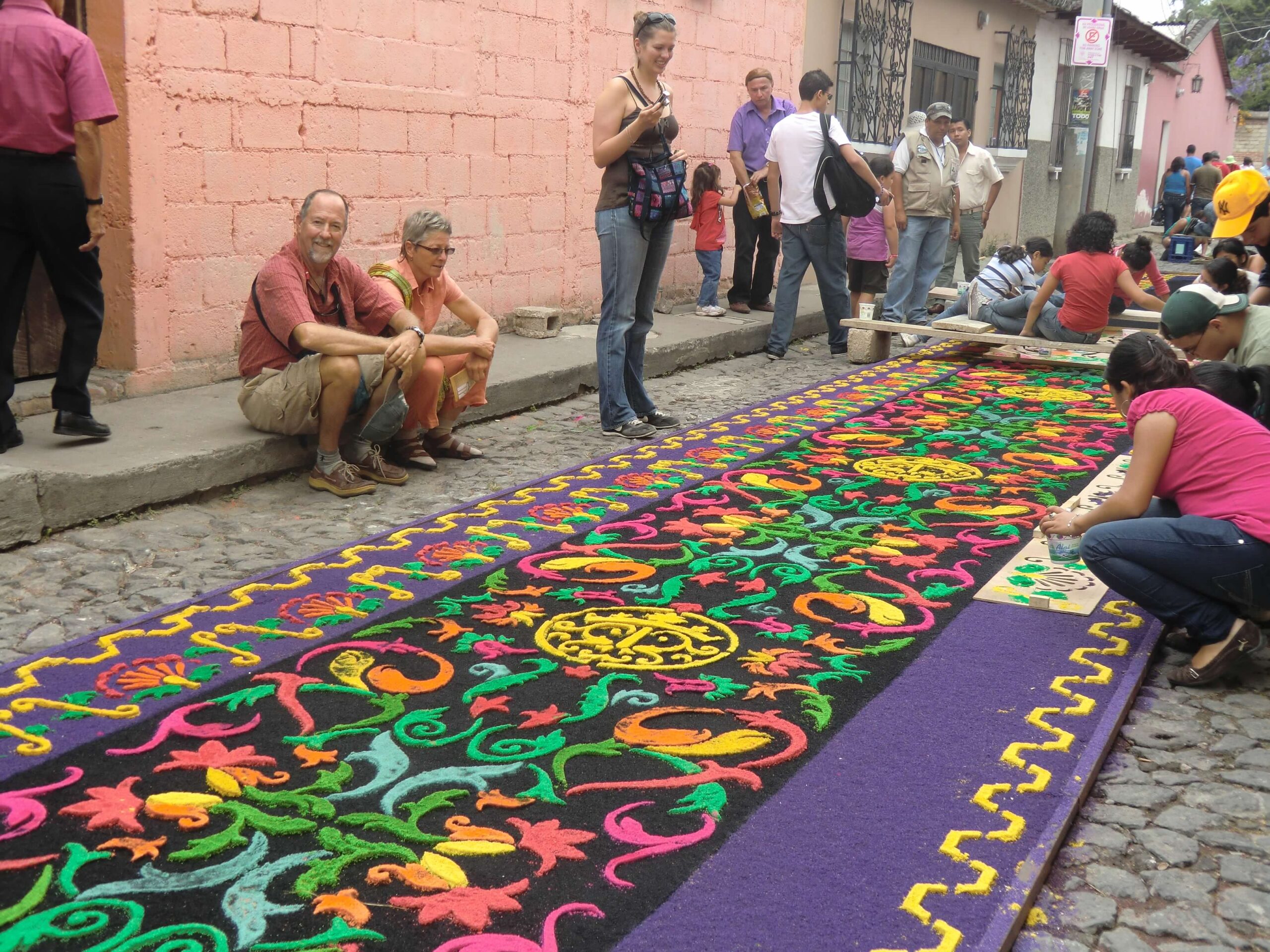
Another characteristic of “our” Semana Santa are the carpets. They are catalogued as Ephemeral art and it is speculated that they come from the Mayans, who used to make them out of feathers, fruit and exotic flowers for rituals and ceremonies. The other possible background goes to the Canary Islands back in the 7th century from the Christian era.
These carpets are probably the most representative icon of the Guatemalan Easter. They are mostly made with dyed saw dust and people have the freedom to choose any designs they want. The groups can be integrated by a Family, a neighborhood or even a company. Some of these carpets are so elaborated that they have to be started a day before they Procesion passes.
They are not only to honor the Image carried in the Procesion, but also carry a message or a meaning. They are like legends. Some are made in memory of a loved one, some are messages of gratitude… making this carpets not only a work of art but a special mean of communication between the makers and the Image they are venerating.
The most popular material is saw dust, but people also use a lot bread, vegetables, fruits and flowers. Some people are more daring and use bottle tops, plastic and wooden toys or anything that will be useful to fulfill the creative burst. Usually, after the Procesion has passed, the poor people and bums pick up the fruits and bread left over.
The chanting and the praying is so intense you will fall into trance. This is one of the most magnificent manifestations of faith, love and pain you can see in a lifetime. Go. Go to Antigua and look for it, it is an unforgettable experience. Watch them when they descend Jesus from the cross, it will bring tears to your eyes, I promise. At least that’s the way it was three years ago, last time I witnessed it by a matter of luck since I had to write a script for a television documentary about it.
Well, fun facts about all of this: the Anda (platform) in average weights 2 tons but it can go up to 3, they are two meters wide and 24 meters long. 140 people carry during each turn, for a block each, they have a long wooden or metal stick that bifurcates at the end which is used to hold the Anda in ever turn shift. There is a small party of men with longer sticks whose sole purpose is to pick up electric wires along the way.
The smell of incense chokes you… and if it rains… oh my God! There will be rivers of colored sawdust flowing turning the streets into a hallucinating scenario while they cover the Images with plastic. Raindrops will be confused with tears. People will stand there, faithful to their beliefs. Guatemala, without a Semana Santa would be incomplete. I took some of above story from Rio Chisme, a local and cruisers web site.
So that’s Semana Santa. Was I moved? Yes by the community involvement of all economic status, the pain witnessed on the faces of the carriers as their bodies sink which puts more stress on either side of you, the tears of past loss, spiritual connection, etc. Catholisim is filled with rituals which I find comforting since my childhood and witnessed during the processions. On a funny note, I kept running into this spanish women carrying her well dressed dog in the churches. She would make sure that the dog saw all the vigils. Everyone has a place in this life I guess!
But Antigua itself is an amazing BEAUTIFUL village with its Colonial ruins and renovated homes along with its cobble stoned streets and Mayan people dressed in their traditional wear that arrive daily from many villages, selling their special weave and art. In addition you also have ALL the MANY tasty fruits and vegetables grown in the highlands. This village was one of Guatemalan’s capitol from 1543 till 1773 when a earthquake destroyed it and they moved the capitol to Guatemala City. It is quite wealthy in Guatemalan standards and houses a lot of x-pats.
To get to this great event that we made reservations for in January, we had to leave Sojourn on a mooring in Roatan, Honduras. We left 2 days after our friend Vicki Staudte from MN arrived. We took a 1 hour ferry to La Ceiba, Honduras, then the following early morning via a 12 hour bus to Antigua, Guatemala. We arrived during a evening procession and had no idea what was going on. Now we understand!